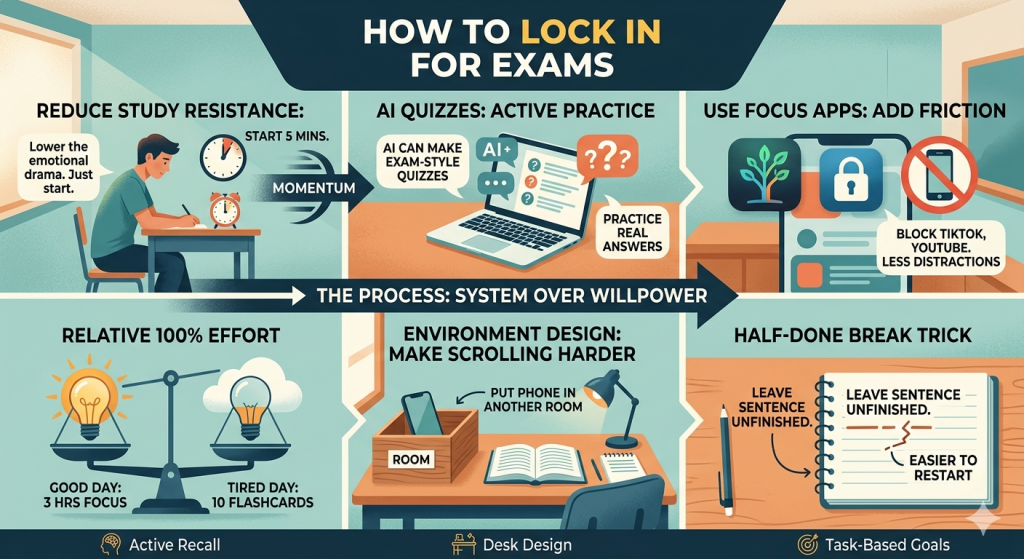
- Start with five minutes to reduce study resistance.
- AI quizzes turn passive notes into active practice.
- Focus apps add friction against distractions.
- Relative effort matters more than perfect performance.
- Environment design beats willpower in weak moments.
When you are learning how to lock in for exams, the trick is not always motivation. Sometimes, the trick is making the first step almost laughably small.
Your brain usually resists the idea of a long study session. But five minutes feels less scary. Once you begin, momentum has a chance to sneak in. So, lower the emotional drama around starting. You are not “locking in forever.” You are just opening the door. Let’s get started.
How to Lock In for Exams: Techniques & AI Study Sprints
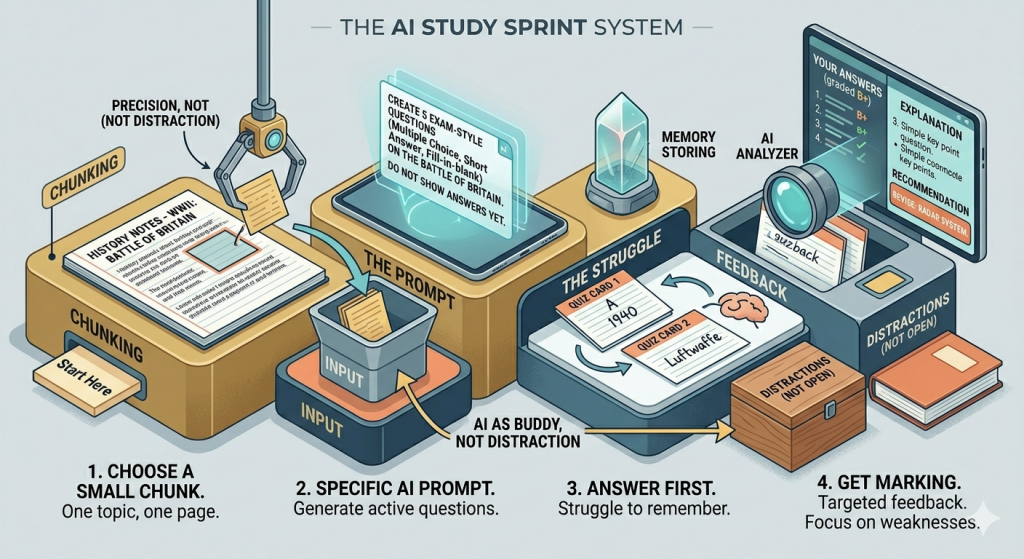
AI can be your study buddy, as long as it does not become your shiny new distraction. When you are learning how to lock in for exams, AI study sprints can help you move faster and study smarter.
- Start with a small chunk of your notes. Do not paste an entire textbook chapter. Choose one topic, one page, or one lesson.
- Ask AI to create five quick questions based only on that material. You can ask for multiple-choice questions, short-answer questions, or fill-in-the-blank prompts.
- Answer the questions before checking the solutions. That little struggle helps your brain remember the information better.
This turns passive reading into active recall.
Try this prompt: “Create five exam-style questions from these notes, but do not show me the answers yet.”
AI can also help you find the topics you only think you understand. After your quiz, paste your answers back into the tool. Ask it to mark them and explain your mistakes in simple language.
You can also ask: “Based on my answers, what should I revise first?”
This helps you stop studying randomly. Instead of panicking about everything, you get a clearer next step.
AI can make mistakes, miss context, or sound confident while being wrong. To avoid this, give it your actual notes, syllabus, or teacher’s material. Ask for questions that match your exam style.
Use words like “mark scheme,” “short answer,” “case study,” or “essay plan.” The more specific your prompt is, the more useful the output becomes.
Use Focus Apps When Your Brain Needs Backup
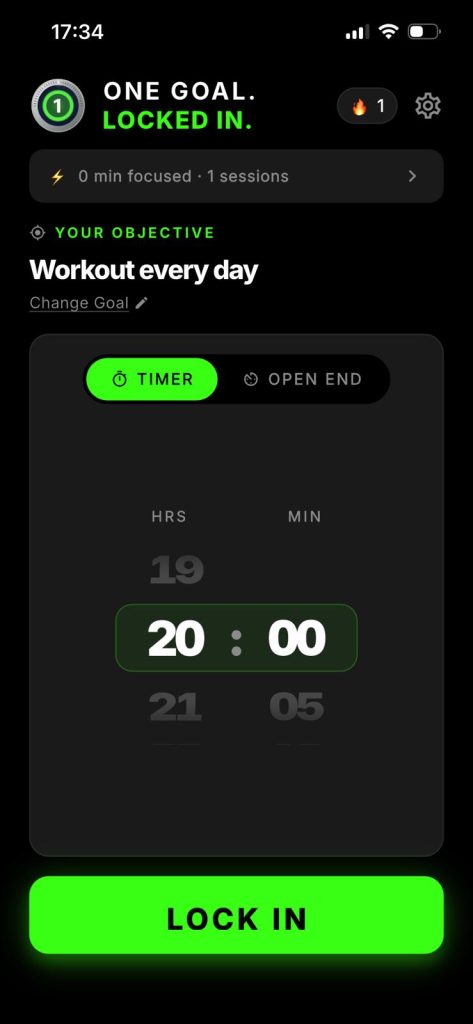
When you are learning how to lock in for exams, the right app can make starting easier. It can block distractions, limit scrolling, or remind you what you are actually meant to be doing.
- One Goal: Locked In is a great option if you want to stay connected to one clear study target. Instead of just blocking apps, it helps anchor your session around a specific goal. That makes it easier to remember why you started before your brain wanders off.
- Forest is useful if you like visual motivation. You plant a virtual tree, and it grows while you stay focused. If you leave the session, your tree suffers.
- Freedom works well if your distractions live across different devices. It can block websites and apps on your phone, laptop, or tablet. This is helpful when your brain simply switches screens to continue the chaos.
- Opal is another strong option for blocking distracting apps during study time. It helps you create focus sessions and makes social apps harder to access when you need to work.
Focus apps work best when you already know your weak spots. If TikTok is the problem, block TikTok. If YouTube becomes “research” suspiciously fast, block that too.
How to Lock In for Exams Without Burning Out
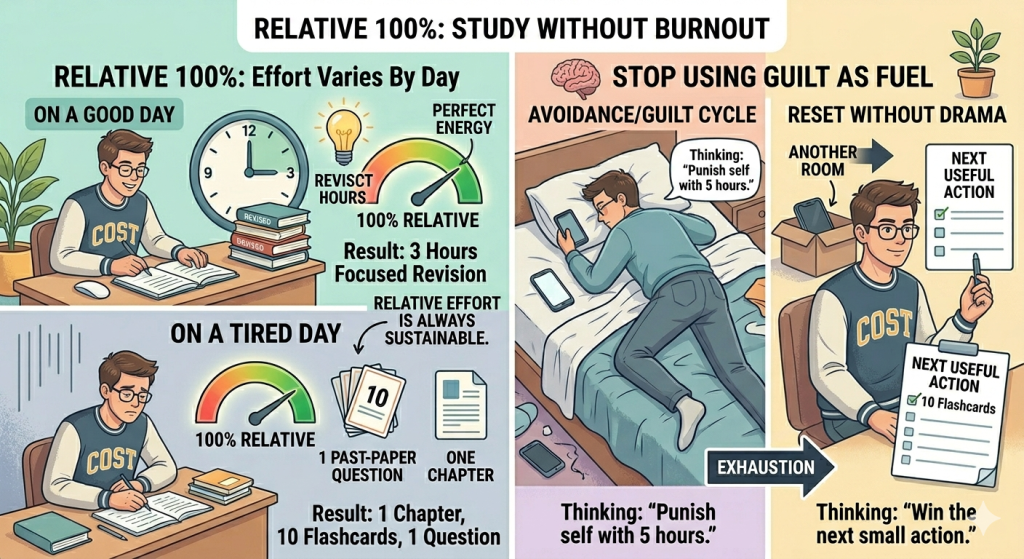
Burnout usually happens when you treat every day like it must be your best day. You expect perfect focus, perfect energy, and perfect motivation. Then one bad session makes you feel like the whole plan is ruined.
Use the “Relative 100%” Rule
The “Relative 100%” rule is simple. You give the best effort you can give today, not the best effort you imagined last week:
- On a good day, your 100% might be three hours of focused revision.
- On a tired day, it might be one chapter, ten flashcards, or one past-paper question.
This makes studying feel less dramatic. You stop judging every session like it is the final scene of a movie.
Stop Using Guilt as Fuel
Guilt feels productive for about three seconds. Then it usually turns into avoidance, scrolling, or lying face-down on your bed.
- You might think, “I wasted the morning, so I need to punish myself with five hours of studying.” Very inspiring. Also, completely exhausting.
- A better move is to reset without the drama. Ask yourself, “What is the next useful thing I can do?”
You are not trying to win the whole day back. You are trying to win the next small action.
How to Lock In for Exams When Motivation Disappears
Motivation is lovely when it shows up. Sadly, it also has the reliability of a group project member. Some days, you feel ready to revise. Other days, your brain acts like studying is a personal attack.
The real skill is learning how to keep going quietly, even when you feel flat, bored, or deeply unimpressed.
Discipline Versus Environment Design
People often say you need more discipline. Sometimes that is true. But most of the time, you need a better environment.
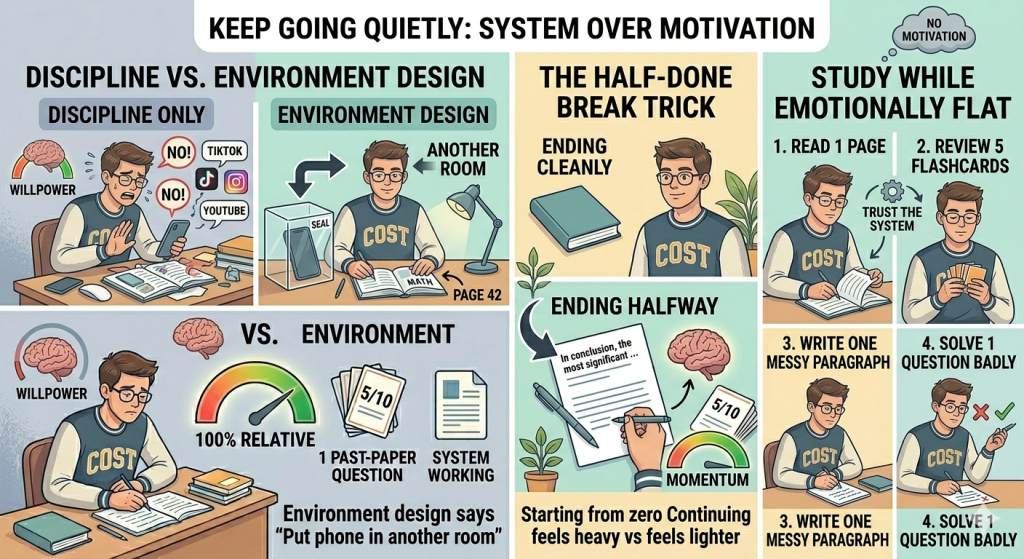
- Discipline says, “Do not check your phone.” Environment design says, “Put the phone in another room.”
- Discipline says, “Stay focused.” Environment design says, “Clear your desk and open the exact page you need.”
This works because your brain follows the easiest option. If scrolling is easier than studying, scrolling wins. Very annoying, but very predictable.
Use the Half-Done Break Trick
Here is a strange little trick: do not always stop at a clean ending. Stop halfway through something simple:
- Leave one sentence unfinished.
- Pause in the middle of a flashcard set.
- Stop after reading the question, before answering it.
This sounds wrong, but it makes restarting easier. Your brain already knows what to do next.
Starting from zero feels heavy. Continuing something half-done feels lighter.
Study While Emotionally Flat
When motivation disappears, lower the emotional expectations. You do not need to feel powerful. You only need to do the next small task:
- Read one page.
- Review five flashcards.
- Write one messy paragraph.
- Solve one question badly, then correct it.
This is how to lock in for exams when your mood is not helping. You stop waiting for a feeling and start trusting the system.
Conclusion
Learning how to lock in for exams is not about becoming perfectly motivated overnight. It is about making studying easier to start, harder to avoid, and less emotionally dramatic. You do not need a perfect study day. You just need the next useful action.
Students Also Ask
How do you lock in for your exams?
To lock in for exams, start with five minutes, remove distractions, use active recall, test yourself with past papers or AI quizzes, and focus on one small task at a time. Consistency beats perfect motivation.
What is the 9 8 7 rule for studying?
The 9-8-7 rule is a study routine: sleep for 9 hours, study for 8 hours, and spend 7 hours on breaks, meals, exercise, and personal time. It is meant to balance productivity with recovery.
How to get locked in for a test?
To get locked in for a test, remove your phone, choose one small task, and start with five minutes. Use quick quizzes, past papers, and short breaks to build focus without overwhelming your brain.
What is the 3-2-1 rule for study?
The 3-2-1 rule usually means: review 3 key ideas, answer 2 practice questions, and write 1 summary from memory. It helps you revise actively instead of just rereading notes.